How to Solve Logic Grid Puzzles: A Beginner-to-Advanced Guide
The short answer
To solve a logic grid puzzle, read every clue, then use each one to cross things off a grid until only one match is still possible. You never guess. Every square gets filled in because a clue, or a chain of clues, forced it. The skill is mostly bookkeeping: mark what each clue rules out, and keep an eye out for rows and columns where only one square is still open.
That's the whole method. The rest of this guide shows how to do it without getting lost, from your first puzzle to the tricky ones with "either/or" clues.
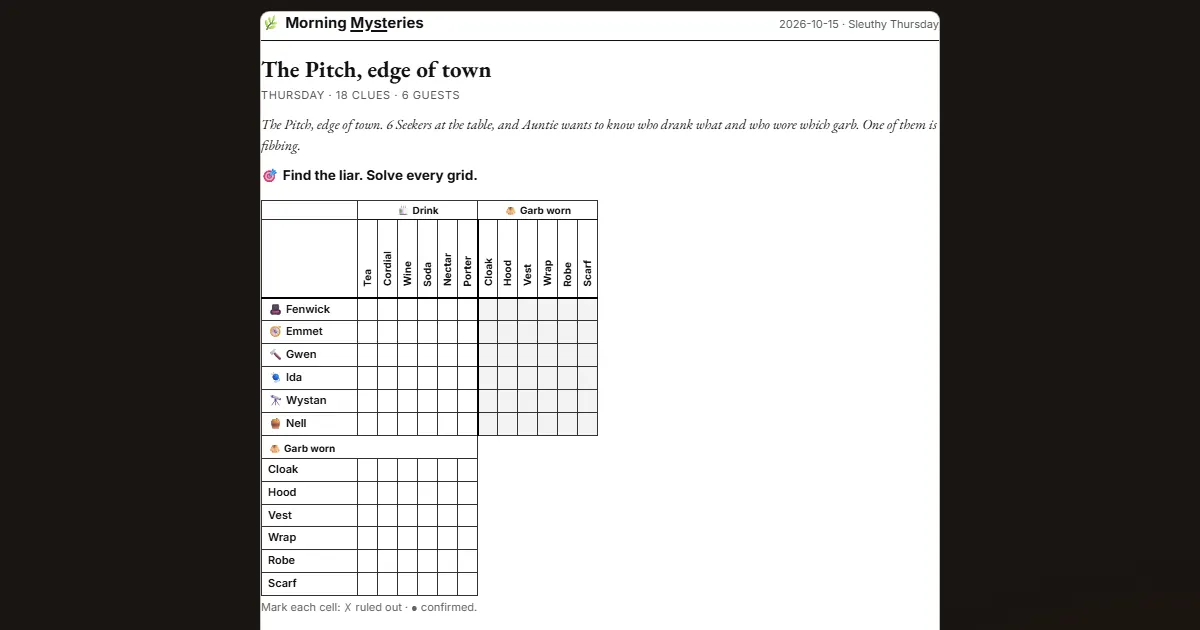
If you'd rather try one first, our daily logic puzzle, Morning Mysteries, is free, needs no account, and has the grid built in. Come back here when you get stuck.
What a logic grid puzzle actually is
A logic grid puzzle gives you a few sets of things (say, suspects, tents and stolen items) and a list of clues. Your job is to work out the single way of matching everything up. Each suspect goes with exactly one tent and exactly one item, and no two suspects share the same one.
The grid is just a notepad. Each block of the grid crosses two sets, and you mark a square with an X when a clue rules that pairing out, or with a circle when a clue confirms it. Our glossary entry on logic grid puzzles has the formal version, and it also mentions that you'll hear these called Einstein puzzles or zebra puzzles.
A well-made one has exactly one solution and can always be reached by deduction alone. If you feel you have to flip a coin, you've missed a step somewhere, because the puzzle never needs a guess.
Before you start
Three habits save you more time than any clever trick.
- Read the whole scenario first - Sometimes a detail that matters (a tent that's already taken, a rule about who can't sit together) is tucked into the story rather than the clue list.
- Use a pencil, or a grid that lets you undo - You will mark a wrong square sooner or later, and being able to fix it cheaply matters more than being clever.
- Know the one rule that does the heavy lifting - Within any block, every row and every column holds exactly one circle. So when you place a circle, you can cross out everything else in that row and that column, and when only one square is left open in a line, it has to be a circle.
A worked example, one clue at a time
Here's a tiny puzzle you can do in your head or on scrap paper. Three travelers (the baker, the weaver and the potter) each sleep in a different tent: red, blue or green.
- The potter's tent is not blue.
- The weaver's tent is not red.
- Either the baker or the potter sleeps in the green tent.
- The baker's tent is not green.
Start with the clues that talk about the same thing. Clue 3 says green belongs to the baker or the potter. Clue 4 says it isn't the baker. So the potter sleeps in the green tent. Circle that square.
Now the rule about rows and columns kicks in. The potter is placed, so the baker and the weaver can't have green. Look at the weaver's row: not red (clue 2), not green (the potter has it). Only blue is left, so that square becomes a circle. The baker gets whatever remains, which is red.
Answer: baker in red, weaver in blue, potter in green. Four clues, three facts, no guessing.
Notice what happened. No clue handed us an answer directly. Two clues combined to place one item, and then crossing things off did the rest. That chain reaction is why a puzzle with only a handful of clues can pin down a dozen facts.
Working with more than two categories
Real puzzles usually have three or four sets, and the grid becomes a staircase of blocks. The extra thing to learn is that the blocks talk to each other.
Suppose you know the baker is in the red tent, and you also know the red tent belongs to the person who lost the lantern. Then the baker lost the lantern, even though no clue said so. Whenever you confirm a match in one block, ask whether it connects two things in another block. If A matches B and B matches C, then A matches C. If A matches B and B does not match C, then A does not match C either.
This is the step beginners skip, and it's usually why they feel stuck. The information is already on the page. It's just sitting in a different block.
Habits that help with harder puzzles
- Mine every clue for more than one fact - "The person in the blue tent isn't the weaver" tells you about two things at once. Mark both squares.
- Do the easy clues first - Direct clues ("the potter has the lantern") go into the grid straight away. Save the wordy ones for when the grid has a few circles to lean on.
- Revisit old clues - A clue that was useless at the start often becomes useful once a few squares fill in. Go back through the list after every few placements.
- Look for the lonely square - After each circle, scan the rows and columns it touches. One open square in a line means a new circle.
- Jot down what you know in plain words - "Baker is red or blue" is a perfectly good note, and it often gets settled later.
When a puzzle gets properly hard: trying a case
Easy puzzles fall to simple elimination. Harder ones include clues that keep two options alive, like "either the baker or the weaver took the jam." You can't circle anything yet, because you don't know which half is true.
The tool for this is to try a case. Pick one half and say "suppose the baker took it." Follow the consequences through the grid as far as they go. If you hit a contradiction (a row with no open squares, or two circles in one column), that case is impossible, and you can safely conclude the other half is true. If you don't hit a contradiction, try the other case and see whether that one breaks.
Two things to keep in mind. Only try cases when you've run out of direct moves, because they cost effort. And keep your trial markings visibly separate from your confirmed ones (a different color of pencil works well, or small dots in the corner of a square) so you can undo a failed case cleanly.
Common mistakes
- Treating a clue as stronger than it is - "Not in the red tent" rules out one square. It doesn't tell you which tent they're in.
- Forgetting the one-to-one rule - If a person already has a tent, nobody else can have it. Cross it off for everyone.
- Fumbling the order clues - Clues like "stood before" or "was never at the end" are about positions in a line, so draw the line and test positions rather than hunting for a match.
- Guessing when stuck - If you're stuck, you've almost certainly missed a combination of two clues. Re-read them side by side.
Other styles of logic puzzle
Not every deduction puzzle uses the classic grid, and getting comfortable with a few styles makes the classic one easier. On Morning Mysteries the style rotates, so you'll meet several:
- Paired statements - Every suspect makes two statements and exactly one in each pair is false. It's a knights-and-knaves twist where you work out which half of each pair holds up.
- Lineup ordering - One line of suspects and positional clues, like who stood before whom. Get the order right and the thief is the one whose story can't fit.
- Directional map puzzles - The clues are spatial (camped north of the well, two stalls left of the baker), and you rebuild the layout from directions alone.
There are also dual-category grids, where two linked grids have to be solved together. The main page describes all five styles, and there's a maximum-difficulty version of each day's puzzle for when the regular one feels too easy.
Practicing
A few ways to build the skill without any pressure:
- Play the daily puzzle at your own pace. Most take about ten minutes. A hint is there if you're stuck, and taking one only adds time to your leaderboard score. It never blocks you from finishing.
- Go back through past mysteries in the archive. Solving an old one just won't land on that day's live leaderboard.
- Print one. The daily pack includes the logic puzzle, and the printable version has a grid big enough to pencil into with the solution on the page after it. That's a nice way to learn, because you can see all of your working.
Frequently asked questions
Are logic grid puzzles the same as zebra or Einstein puzzles?
They're the same family. "Zebra puzzle" and "Einstein puzzle" are names for a widely shared example about five houses, and people use them loosely for any puzzle where you match items across several sets using clues.
Do I ever need to guess?
No. A properly built logic grid puzzle has one solution and can be solved by deduction alone. If you feel you need to guess, look for a pair of clues you haven't used together yet, or try a case and follow it until it breaks.
How long should a logic puzzle take?
It depends on size and difficulty. Our daily mystery usually takes about ten minutes, and the difficulty climbs through the week, so Monday is gentler than Friday.
What's the best way to mark the grid?
Use an X for "definitely not" and a circle or tick for "definitely yes." Stick to the same marks every time, and add a third, lighter mark for tentative ideas that you can erase.
Can I play without signing up?
Yes. Morning Mysteries is free and works without an account. Signing in only saves your solve times and streak.
Comments