How to Solve a Cryptogram: A Step-by-Step Method for Beginners
The short answer
A cryptogram is a short quote or proverb where every letter has been swapped for a different one, always the same swap. To solve it, start with the shortest and most repeated words, guess a few letters from English patterns, and let each correct guess fill in everywhere at once. One-letter words are almost always A or I, and a three-letter word that shows up again and again is probably THE.
You don't need to be a codebreaker. You need a method, a pencil, and a bit of patience. Here's the method, with a full worked example, and then a look at how it applies to the emoji version we run every day at Daily Decode.
What a cryptogram is
In a cryptogram, a piece of text has been encrypted by replacing each letter with a different letter or symbol. Your job is to work out the substitution and read the message back. The swap is consistent: whatever stands in for E at the start stands in for E everywhere.
That consistency is the whole solving method. Our glossary entry on cryptograms also makes a point worth remembering: a cryptogram is a cipher rather than a code. It works letter by letter, not word by word, which is why patterns in letters and word shapes give it away.
Word spacing and punctuation are normally left alone. That's a gift, because word lengths and apostrophes are some of your best clues.
The method, step by step
- Copy the puzzle and leave room - Write the cipher text on paper with a blank line under each letter, or print it with space to write. Work in pencil.
- Make a tally - Count how many times each cipher letter appears. The most common cipher letter is probably standing in for E, T, A, O, I or N, which carry most English text.
- Look for one-letter words - In English these are almost always A or I.
- Look for the short, repeated words - A three-letter word that appears several times is very likely THE or AND. Common two-letter words include OF, TO, IN, IT, IS, BE and AS.
- Use the apostrophe - An apostrophe followed by a single letter is usually S or T, as in "it's" or "don't".
- Check double letters - LL, EE, SS, OO and TT are common. Doubled consonants like JJ don't occur.
- Fill in everywhere - Every time you decide a letter, write it under every matching cipher letter. Words start to take shape, and the new shapes suggest the next guess.
- Back out when something breaks - If a word comes out as nonsense, one of your earlier guesses was wrong. Erase the most recent one first.
A worked example
Here's a small cryptogram, built so you can follow every step:
ZIT TQKSN WOKR EQZEITL ZIT VGKD.
Start with the repeated word. ZIT appears twice and is three letters long, so it's very likely THE. Write T-H-E under every Z, I and T in the puzzle. Now the second word, TQKSN, starts with an E (because T means E). Five letters, starting with E: EARLY fits nicely, so Q is A, K is R, S is L and N is Y.
Next, WOKR is four letters and ends in an R we've already placed: _ _ R _. Filling in what we know, BIRD works, so W is B, O is I, and R is D.
Now EQZEITL: it reads _ A T _ H E _. CATCHES fits, which makes E equal to C and L equal to S. The last word, VGKD, has an R in the third spot: _ _ R _. WORM is a good fit, so V is W, G is O, and D is M.
Read it back: THE EARLY BIRD CATCHES THE WORM. Every correction was a small, checkable guess, and each one unlocked the next.
Notice that nothing needed luck. The repeated three-letter word gave us a foothold, and after that we used word shapes and the letters we already had.
Letter patterns worth memorizing
- Most common letters - E, T, A, O, I, N, then S, H and R.
- Common endings - ING, ED, LY, TION and ER often show up at the end of longer words.
- Common pairs - TH, HE, IN, ER, AN and RE appear constantly.
- Q - It's almost always followed by U.
- Word shapes - A word with a repeated letter in a particular position narrows things fast. A six-letter word whose third and fourth letters match could be LETTER, BUTTON or BOTTLE, and that single clue rules out most other words.
Harder versions
Puzzle magazines call the version that keeps the word spacing an Aristocrat. The harder version runs the letters together in blocks and is called a Patristocrat. With no word breaks you lose the one-letter-word and short-word tricks, so you lean on letter frequency, common pairs and endings instead. Start by hunting for the commonest pairs and trios of letters, like TH, HE and ING, and build outward.
One more thing to watch for: some puzzles, including the ones our generator builds, never let a letter stand for itself. If you know that rule applies, you can cross out that option at once. Check how a particular puzzle is built before you rely on it.
Solving our Daily Decode
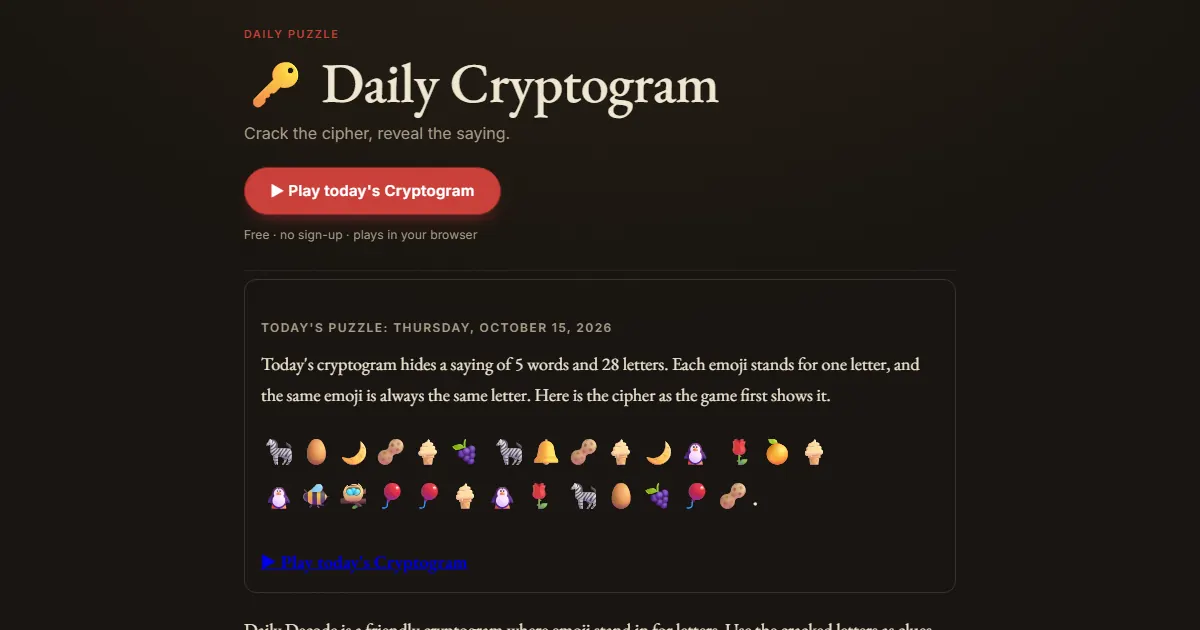
Daily Decode is a friendly version of the same puzzle, with emoji standing in for letters. Each emoji always maps to the same letter, and the hidden saying is a short proverb, the same for everyone that day. Here's how it plays:
- The puzzle walks you through it - It picks a symbol and you tap the letter you think it stands for. You can also tap any symbol in the phrase to jump straight to it.
- Some letters are given - A few are revealed at the start as a foothold.
- Correct guesses spread - A correct letter fills in everywhere that symbol appears, so the puzzle gathers speed as it goes.
- A keyboard with a little help - The on-screen letter keys can show a small bar for how common each letter is in the answer, which is a nice way to practice frequency thinking.
- Hints exist - "Reveal a letter" breaks a logjam without giving the whole saying away.
- The clock keeps score - Your solve time goes on the daily board, and each wrong guess or hint adds five seconds to it.
Because the phrases are short proverbs, the same habits apply. Look for repeated short words and common word shapes, and use the letters already revealed to make your first guess. It's free, plays in your browser, and doesn't need an account. After you solve it, you can try that cipher again for practice.
Making your own cryptogram
Once you can solve them, making one is fun. Our free cryptogram generator turns any phrase into a letter-substitution puzzle. You choose how many letters to give away, and you can print the answer key on its own page. A few tips from the tool itself:
- Longer phrases are easier - More text means more repeated letters and more word shapes to work with. A six-word quote is a pleasant ten minutes, while a four-word one can be genuinely impossible.
- Ordinary words beat clever ones - A phrase of common English words solves itself once THE and AND fall.
- Give one letter away - It changes a cryptogram from intimidating to inviting and costs almost nothing in difficulty.
- Solve your own first - If you can't make a start on your own puzzle with the hints you chose, nobody else will either.
If you enjoy rearranging letters, our daily anagram puzzle is a good next step.
Frequently asked questions
What is the easiest way to start a cryptogram?
Look for one-letter words (A or I) and for a short word that repeats (often THE). Then count the letters and guess the most common one as E or T.
Is a cryptogram the same as a code?
Not quite. A cryptogram is a cipher: each letter is swapped for another letter or symbol. A code swaps whole words or phrases. Because cryptograms work letter by letter, patterns in the text give them away.
What if I get stuck?
Re-read the words you've already filled in for a near miss, and erase the latest guess first. In Daily Decode you can also use "Reveal a letter" to move forward without losing the whole saying.
Is Daily Decode the same for everyone?
Yes. Everyone decodes the same date-seeded proverb or quote each day, and a new cipher arrives every day.
Do I need an account to play?
No. Daily Decode is free and plays in your browser. Signing in only saves your streak and puts your time on the leaderboard.
Comments